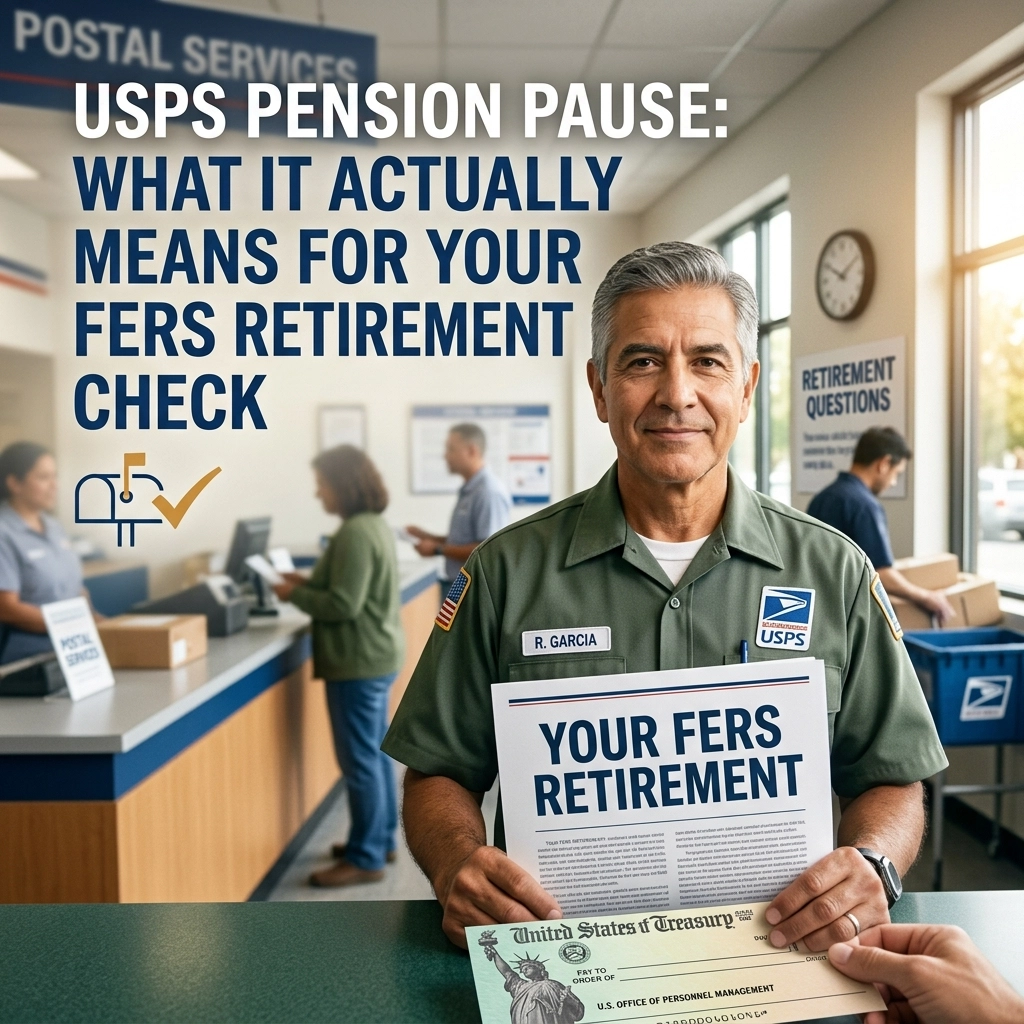
If you’ve been scrolling through your news feed lately and saw the words “USPS” and “Pension Pause” in the same sentence, your heart rate probably spiked faster than a Priority Mail Express package. We get it. When you’ve spent decades hauling mail through rain, sleet, snow, and that one neighbor’s very aggressive Chihuahua, the last thing you want to hear is that your retirement check might be in limbo.
But before you start hiding your life savings in a coffee can in the backyard, let’s take a collective deep breath. As of April 2026, the United States Postal Service has indeed hit the “pause” button on some payments, but it’s not exactly the apocalypse the headlines make it out to be.
At Federal Benefits Service, we’re all about making the complex simple. So, let’s break down what’s actually happening, why USPS is currently checking the couch cushions for spare change, and why your FERS retirement check is safer than you think.
The Big “Pause”: What Happened in April 2026?
Starting in April 2026, the USPS announced a temporary suspension of its employer contributions to the Federal Employees Retirement System (FERS). Essentially, the Postal Service told the government, “Hey, we’re a bit short on cash right now. We’re going to stop putting our portion into the pension fund for a minute while we get our house in order.”
Why? Because the USPS is facing a bit of a financial squeeze. Between rising operational costs and a cash-flow crisis that could see them running out of liquid funds by 2027, they needed to free up some capital. By pausing these contributions, they’re looking to save about $2.5 billion this fiscal year alone.
But, and this is a huge “but”, this pause is on the employer side only.

What is NOT Paused (The Good News)
It is very important to do your own analysis of your paystub, but here is the general reality for the average postal worker:
- Your Contributions: The money taken out of your paycheck for FERS is still being taken out and sent where it needs to go. You are still paying your dues.
- TSP Matches: This is the big one. Your Thrift Savings Plan (TSP) contributions and, more importantly, the USPS 5% match are still happening. The pause does not affect the TSP.
- Social Security: USPS is still paying into Social Security for you.
- Service Credit: You are still earning time toward your retirement. This “pause” doesn’t mean your years of service stop counting. If you work through 2026, you get credit for 2026.
Why Your Retirement Check Isn’t Going Anywhere
If you are already retired, or if you are planning to retire soon, you might be wondering: “If USPS isn’t paying into the fund, how do I get paid?”
Here is the secret: USPS doesn’t pay your retirement check. The Office of Personnel Management (OPM) does.
Think of it like a giant bucket. USPS and its employees throw money into the bucket (the Civil Service Retirement and Disability Fund) while you’re working. When you retire, OPM takes a ladle, scoops money out of that giant bucket, and pours it into your bank account.
Even though USPS has stopped pouring their “employer share” into the bucket for a while, the bucket is already incredibly large. More importantly, your right to that money is guaranteed by law. The benefits you’ve earned are a legal obligation of the federal government, not just a “pinky promise” from the Postmaster General.

Deja Vu? This Has Happened Before
If you feel like you’ve heard this story before, it’s probably because you have. Back in 2011, the USPS did almost the exact same thing. They were facing a similar cash crunch and suspended employer contributions to the FERS fund.
What happened then? Life went on. Retirees got their checks. Employees kept earning service credit. A few months later, the financial situation stabilized, USPS resumed payments, and they eventually made up for the missed contributions.
The 2026 “pause” is a strategic move to keep the lights on and the trucks moving. It is a funding issue at the corporate level, not a benefit cut at the individual level.
Conservative vs. Aggressive: Managing Your Own Funds
While the FERS pension is the “steady” part of your retirement, the TSP is where you have the most control. Even with the USPS financial drama, your TSP strategy should remain focused on your personal goals.
It is very important to do your own analysis when looking at your investment allocations. For informational purposes, many postal employees look at these general benchmarks for long-term planning:
- Conservative Strategy: (Heavy G Fund/F Fund) – Aiming for a 3.00% annual return.
- Moderate Strategy: (Balanced L Fund or mix of C/S/I) – Aiming for a 6.00% annual return.
- Aggressive Strategy: (Heavy C and S Funds) – Aiming for a 9.00% annual return.
NOTICE: These figures are purely for illustrative purposes and do not represent guaranteed returns. Always set a meeting in Benefits Review to discuss your specific situation.
LEGAL NOTICE AND COMPLIANCE DISCLAIMER
DO YOUR OWN RESEARCH. The information provided in this blog post is for general informational purposes only. Federal Benefits Service is not a government agency, and we are not affiliated with the USPS, OPM, or the Social Security Administration.
NO INVESTMENT ADVICE. The content here does not constitute financial, legal, or tax advice. Every individual’s retirement situation is unique, governed by specific dates of hire, retirement systems (FERS, FERS-RAE, or FERS-FRAE), and career history.
LIMITATION OF LIABILITY. While we strive to provide accurate and up-to-date information regarding the April 2026 USPS funding changes, we make no representations or warranties of any kind, express or implied, about the completeness, accuracy, or reliability of this information. Any reliance you place on such information is strictly at your own risk. It is very important to do your own analysis and consult with a professional financial advisor before making any decisions regarding your federal benefits or retirement timing.
What Should You Do Right Now?
If you’re a USPS employee, your “To-Do” list is actually pretty short:
- Keep Working: Your service credit is safe.
- Check Your Paystub: Ensure your employee FERS contributions and TSP deductions are still being processed correctly.
- Don’t Stop Your TSP: Some people panic and stop contributing to their TSP because they hear the word “pension pause.” Don’t leave free money on the table! The 5% match from USPS is still active.
- Stay Informed: Keep an eye on official USPS News and OPM announcements.
- Set a Meeting in Benefits Review: If you are within 5 years of retirement, now is a great time to get a professional look at your “Blue Book” and ensure your ducks are in a row.
The Bottom Line
The USPS pension pause is definitely a sign that the Postal Service is navigating some rough financial waters. However, for you, the hard-working carrier, clerk, or supervisor, it is largely a “behind-the-scenes” accounting move.
Your retirement check is a legally protected benefit. As long as OPM is still standing (and they aren’t going anywhere), your FERS annuity is secure. The USPS might be pausing their contributions to the fund, but you shouldn’t pause your retirement dreams.

Procedural Instructions for USPS Employees
To ensure you are maximizing your benefits during this period of agency-level financial adjustment, please follow these instructional steps:
- Download the Mobile Application: Access your LiteBlue account regularly via mobile or desktop to monitor your eOPF (Electronic Official Personnel Folder).
- Review your TSP Allocation: Use the official TSP website to confirm your funds are allocated according to your risk tolerance (Conservative 3%, Moderate 6%, or Aggressive 9%).
- Contact Representatives: If you notice discrepancies in your service credit or FERS withholdings, contact your HRSSC (Human Resources Shared Service Center) immediately.
- Utilize Professional Tools: Use the retirement calculators provided by Federal Benefits Service to estimate your future annuity based on current high-3 projections.
By staying proactive and ignoring the “sky is falling” rhetoric, you can navigate the 2026 USPS pension pause with confidence. Remember, the mail must go out, and your retirement planning must go on.
It is very important to do your own analysis. Seek independent, professional guidance to verify how these systemic changes impact your personal financial trajectory. Stay focused on the long game, and don’t let a temporary “pause” derail your future.