The Thrift Savings Plan represents one of the most significant components of federal retirement benefits, yet a substantial number of federal employees continue to make critical errors regarding beneficiary designations that could have severe financial consequences for their surviving family members. This analysis examines the most prevalent mistakes and provides explicit guidance for corrective measures.
IMPORTANT DISCLAIMER: This content is provided for informational purposes only and does not constitute financial, legal, or investment advice. Federal employees must conduct their own research and consult with qualified professionals before making any decisions regarding their TSP accounts or beneficiary designations.
CRITICAL MISTAKE #1: FAILURE TO MAINTAIN CURRENT BENEFICIARY DESIGNATIONS
The most significant and widespread error among federal employees involves neglecting to update TSP beneficiary forms following major life events. Research indicates that a substantial percentage of federal employees complete their initial beneficiary designation during onboarding and subsequently fail to review or update these critical documents for years or even decades.
This oversight becomes particularly problematic when considering the legal implications. TSP beneficiary forms supersede any beneficiary designations contained within wills or other estate planning documents. Regardless of specific language in a will, TSP funds will be distributed exclusively according to the most recent beneficiary form on file with the Thrift Savings Plan.
WARNING: Failure to update beneficiary forms can result in unintended recipients receiving your TSP account balance, including former spouses following divorce proceedings.
Default Distribution Order
When federal employees fail to designate beneficiaries or when designated beneficiaries predecease the account holder, TSP implements the following statutory distribution order:
- Surviving spouse
- Children in equal shares, including descendants of deceased children
- Parents in equal shares, or surviving parent
- Appointed executor or administrator of the estate
- Next of kin entitled to the estate under applicable state laws
This default sequence may not align with individual circumstances, particularly in cases involving blended families, non-traditional family structures, or specific financial needs of surviving dependents.

CRITICAL MISTAKE #2: INADEQUATE UNDERSTANDING OF LEGAL PRECEDENCE
Federal employees frequently operate under the misconception that their wills control the distribution of TSP assets. This fundamental misunderstanding can result in significant estate planning errors and unintended financial consequences for surviving family members.
LEGAL CLARIFICATION: TSP beneficiary designations constitute contractual obligations that supersede testamentary dispositions. Wills, trusts, and other estate planning instruments cannot override properly executed TSP beneficiary forms.
The legal precedence of beneficiary forms extends beyond simple distribution preferences. These documents create binding contractual relationships between the account holder, the TSP, and designated beneficiaries. Courts consistently uphold the validity of beneficiary forms over conflicting provisions in wills or other estate planning documents.
CRITICAL MISTAKE #3: PROCRASTINATION IN POST-DIVORCE UPDATES
Divorce proceedings frequently result in complex financial restructuring, yet many federal employees fail to update TSP beneficiary designations promptly following final divorce decrees. This oversight can result in former spouses receiving substantial retirement assets, regardless of divorce settlement agreements or subsequent remarriage.
IMMEDIATE ACTION REQUIRED: Federal employees must update TSP beneficiary forms immediately following divorce finalization. Failure to complete this action may result in unintended asset transfer to former spouses.
State laws vary significantly regarding the automatic revocation of beneficiary designations following divorce. Some states automatically void former spouse designations, while others maintain these designations unless explicitly changed. Federal employees cannot rely on state law variations and must take direct action to ensure proper beneficiary updates.
CRITICAL MISTAKE #4: INSUFFICIENT BENEFICIARY SPECIFICITY
Many federal employees provide inadequate identifying information when completing beneficiary forms, potentially creating administrative delays or disputes during claim processing. Common deficiencies include:
- Incomplete legal names
- Missing Social Security numbers
- Outdated addresses
- Ambiguous relationship designations
- Percentage allocation errors
These administrative deficiencies can result in significant delays in benefit distribution and may require legal intervention to resolve competing claims.
CORRECTIVE MEASURES AND COMPLIANCE PROCEDURES
Form TSP-3 Completion Requirements
Federal employees must complete Form TSP-3 (Designation of Beneficiary) to establish proper beneficiary designations. This form requires specific information including:
- Complete legal names of all beneficiaries
- Social Security numbers for all designated individuals
- Current addresses for all beneficiaries
- Specific percentage allocations totaling 100%
- Clear designation of primary and contingent beneficiaries
COMPLIANCE REQUIREMENT: All beneficiary forms must be properly notarized or witnessed according to TSP requirements. Improperly executed forms may be deemed invalid.
Systematic Review Procedures
Federal employees must establish systematic review procedures to ensure beneficiary designations remain current and accurate. Recommended review triggers include:
- Marriage or remarriage
- Divorce or separation
- Birth or adoption of children
- Death of designated beneficiaries
- Significant changes in family relationships
- Every three years as standard practice
It is very important to do your own analysis of your specific circumstances and consult with qualified estate planning professionals to ensure proper coordination with overall financial planning objectives.
Documentation and Communication Protocols
Federal employees should maintain comprehensive documentation of all beneficiary designations and communicate relevant information to family members and financial advisors. Essential documentation includes:
- Copies of all executed beneficiary forms
- Confirmation receipts from TSP processing
- Regular account statements showing current beneficiary information
- Coordination documents with other retirement accounts

PROFESSIONAL CONSULTATION REQUIREMENTS
NO INVESTMENT ADVICE: The information contained herein does not constitute investment advice or recommendations. Federal employees must seek independent professional guidance for their specific circumstances.
Complex family situations, substantial account balances, or coordination with other estate planning instruments require professional consultation with qualified financial advisors, estate planning attorneys, or tax professionals. These professionals can provide personalized analysis of individual circumstances and ensure proper integration with comprehensive financial planning strategies.
Federal employees should specifically consult with professionals regarding:
- Tax implications of beneficiary designations
- Coordination with other retirement accounts
- Estate planning strategies for high-value accounts
- Trust considerations for minor beneficiaries
- Special needs planning for disabled beneficiaries
IMMEDIATE ACTION ITEMS
Federal employees must take immediate action to address potential beneficiary designation deficiencies:
- Access your TSP account online or contact TSP directly
- Review current beneficiary designations for accuracy and completeness
- Complete Form TSP-3 if updates are required
- Ensure proper notarization or witnessing of all forms
- Maintain copies of all executed documentation
- Set calendar reminders for systematic future reviews
RISK WARNING: Delays in addressing beneficiary designation issues may result in unintended asset distribution and significant financial consequences for surviving family members.
CONCLUSION AND COMPLIANCE STATEMENT
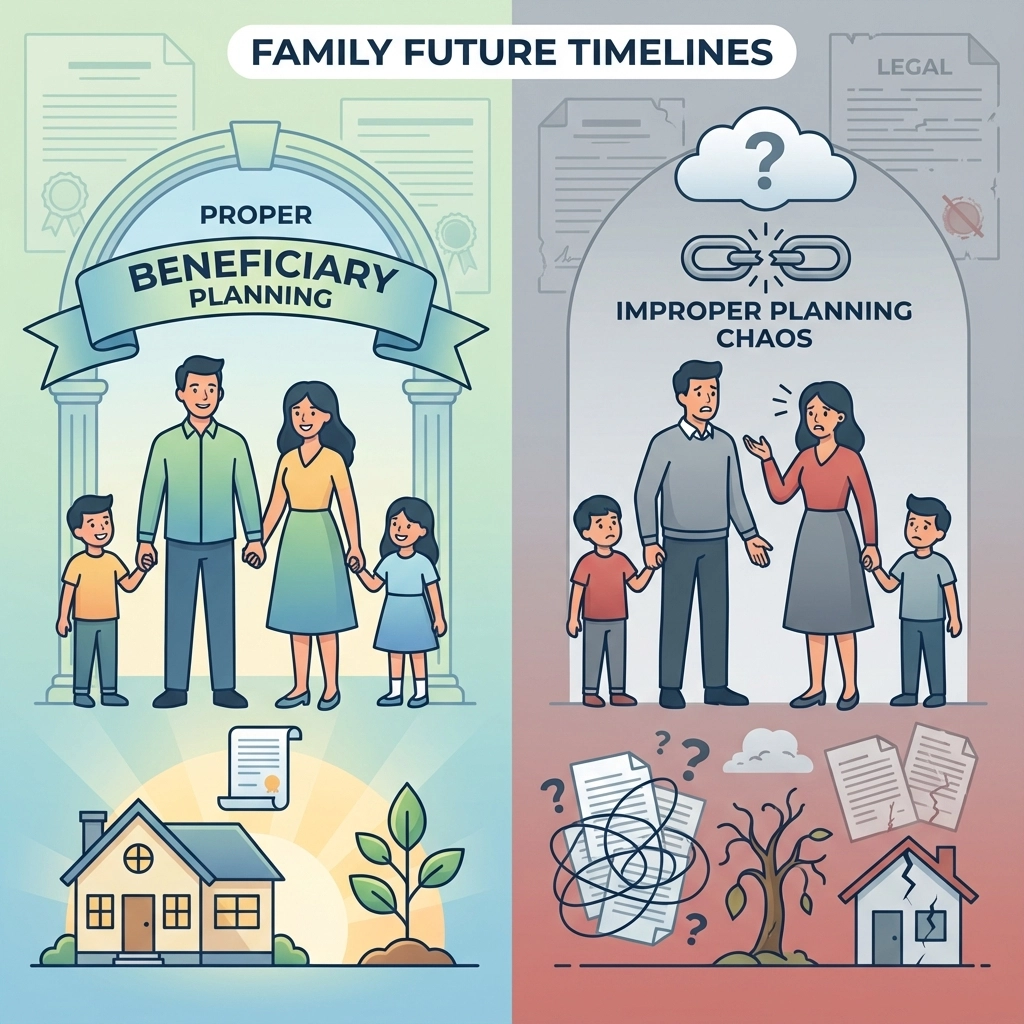
Proper TSP beneficiary designation management represents a critical component of comprehensive retirement planning for federal employees. The mistakes outlined in this analysis can result in significant financial consequences and family disputes that could be easily avoided through proper planning and regular maintenance of beneficiary forms.
FINAL DISCLAIMER: This information is provided for educational purposes only. Federal employees must conduct their own research and seek professional guidance appropriate to their individual circumstances. No content herein should be construed as specific financial, legal, or investment advice.
Federal employees are encouraged to contact TSP directly at 1-877-968-3778 or visit the official TSP website for specific questions regarding beneficiary designations and account management procedures. Professional consultation with qualified advisors is strongly recommended for complex situations or significant account balances.
DO YOUR OWN RESEARCH: Individual circumstances vary significantly, and federal employees must evaluate their specific situations with appropriate professional guidance before making any decisions regarding TSP beneficiary designations or estate planning strategies.