IMPORTANT DISCLAIMER: This article is for informational purposes only and does not constitute investment advice, tax advice, or financial planning recommendations. Federal employees must conduct their own research and consult with qualified financial professionals before making any TSP withdrawal decisions. The Federal Benefits Service does not provide investment advice and is not liable for any financial decisions made based on this content.
Understanding TSP Withdrawal Rules for Federal Employees
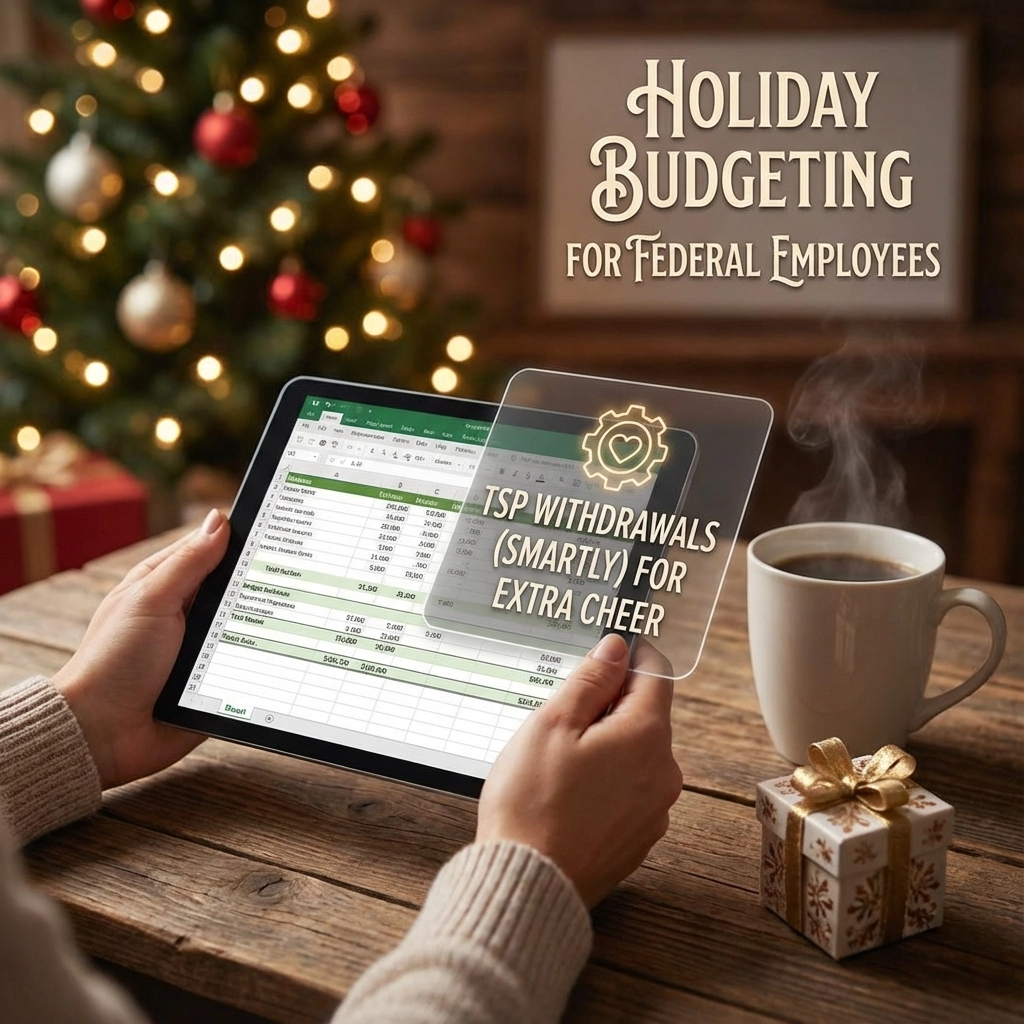
The Thrift Savings Plan (TSP) serves as a critical retirement savings vehicle for federal employees across all agencies, including the United States Postal Service, Veterans Administration, Law Enforcement Officers, Department of Defense, Department of Labor, and other federal departments. During the holiday season, many federal employees consider accessing these funds for additional expenses.
It is very important to do your own analysis and understand that TSP withdrawals have significant long-term implications for your retirement security.
Federal employees operating under the Federal Employees Retirement System (FERS) must understand that premature TSP withdrawals can substantially impact their retirement readiness. The TSP withdrawal rules are governed by strict federal regulations that apply uniformly across all agencies.
Early Withdrawal Penalties and Tax Implications
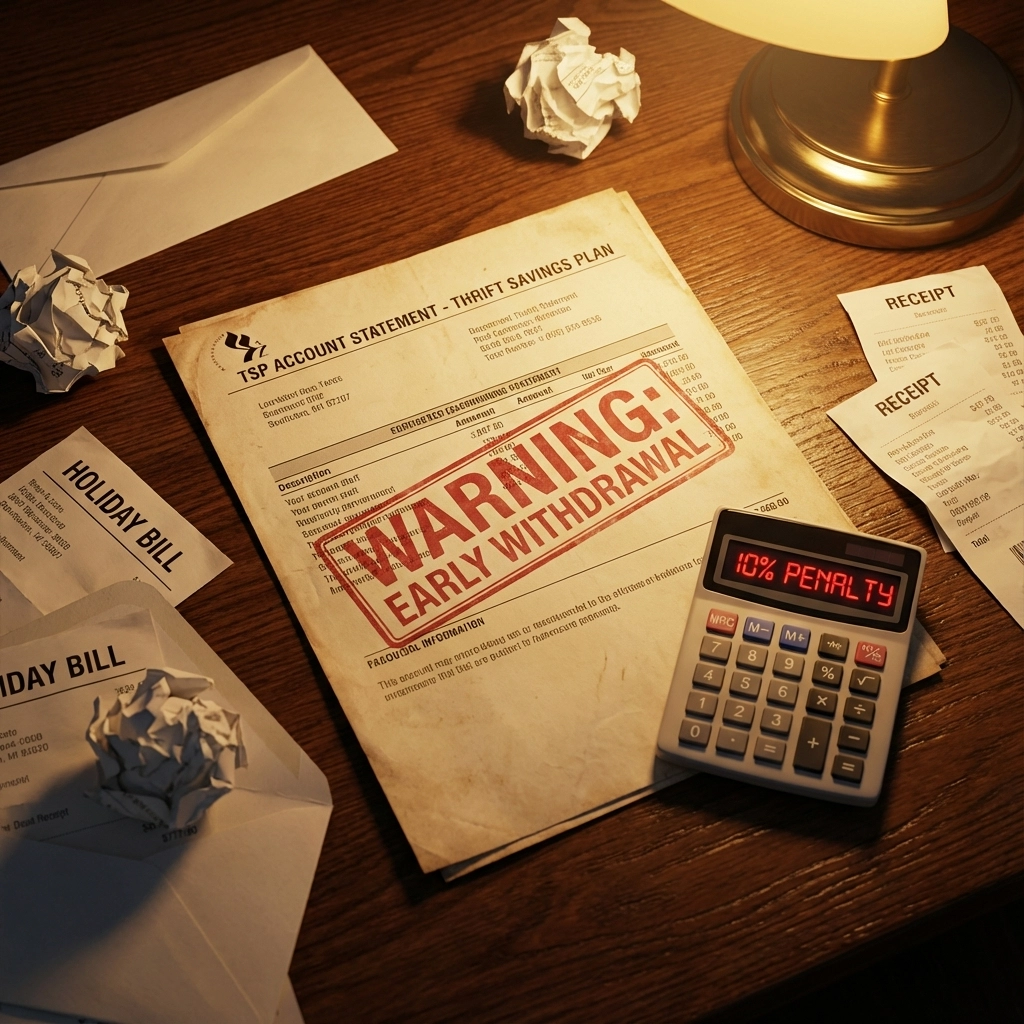
WARNING: Early TSP withdrawals before age 59½ typically incur a 10% penalty plus ordinary income taxes.
Federal employees from the United States Postal Service, Veterans Administration, Law Enforcement Officers, Department of Defense, and Department of Labor face identical penalty structures:
- 10% Early Withdrawal Penalty: Applied to the full withdrawal amount
- Ordinary Income Tax: Withdrawals taxed at your current marginal tax rate
- State Tax Implications: Varies by state of residence
- Reduced Future Growth: Permanent loss of compound growth potential
CRITICAL NOTICE: The combination of penalties and taxes can reduce your withdrawal by 30-40% or more.
Holiday Budgeting Strategies Without TSP Withdrawals
Before considering TSP access, federal employees should exhaust alternative holiday funding strategies. These approaches preserve retirement security while addressing seasonal financial needs.
Alternative Holiday Funding Sources
Federal Employee Savings Options:
- Holiday Club Accounts: Dedicated seasonal savings accounts
- Annual Leave Payouts: Converting excess annual leave to cash
- Overtime Opportunities: Available through United States Postal Service, Department of Defense, and other agencies during peak holiday periods
- Temporary Duty (TDY) Savings: Accumulated per diem savings for Defense Department and other traveling federal employees
DO YOUR OWN RESEARCH: Consult with your agency’s human resources department regarding leave conversion policies and overtime eligibility.
Budget Restructuring for Federal Employees
FERS participants should consider systematic budget adjustments rather than retirement account raids:
Monthly Budget Allocation Strategy:
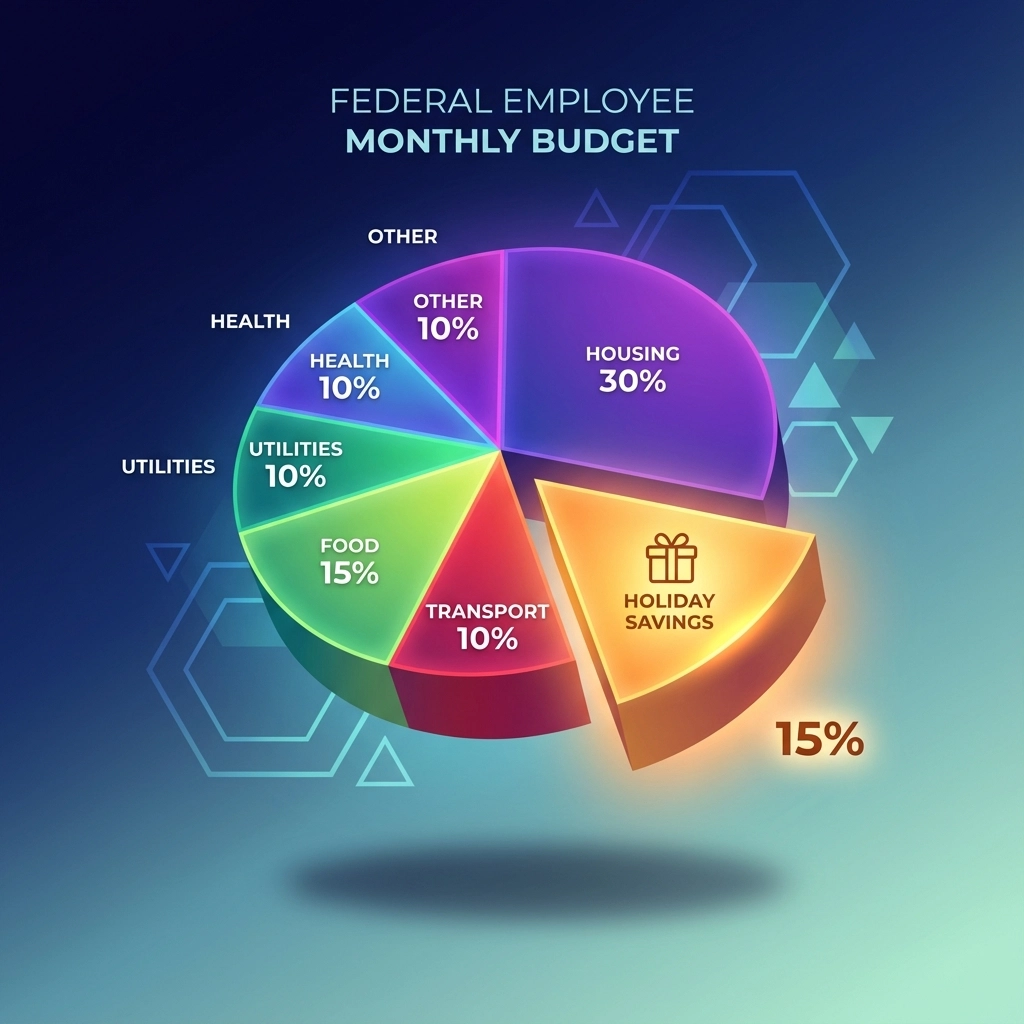
- Conservative Approach: Allocate 2% of monthly salary to holiday fund starting in January
- Moderate Approach: Allocate 3-4% of monthly salary beginning in February
- Aggressive Approach: Allocate 5-6% of monthly salary starting in March
IMPORTANT NOTICE: These percentages are examples only and do not constitute financial advice. Individual circumstances vary significantly.
TSP Loan Considerations for Federal Employees
If federal employees determine that TSP access is necessary, TSP loans present a potentially less damaging alternative to outright withdrawals for United States Postal Service, Veterans Administration, Law Enforcement Officers, Department of Defense, and Department of Labor employees.
TSP Loan Requirements and Limitations
TSP Loan Eligibility:
- Minimum loan amount: $1,000
- Maximum loan amount: 50% of vested account balance or $50,000, whichever is less
- Repayment period: 1-5 years for general purpose loans
- Interest rate: TSP G Fund interest rate plus 1%
CRITICAL WARNING: TSP loans must be repaid within specified timeframes. Defaulted loans are treated as taxable distributions subject to penalties.
TSP Loan Repayment Considerations
Federal employees under FERS must understand that TSP loan repayments occur through payroll deduction. This affects take-home pay for the loan duration.
Repayment Impact Analysis:
- $5,000 Loan: Approximately $90-100 monthly payroll deduction over 5 years
- $10,000 Loan: Approximately $180-200 monthly payroll deduction over 5 years
- $15,000 Loan: Approximately $270-300 monthly payroll deduction over 5 years
NO INVESTMENT ADVICE: These calculations are estimates. Actual repayment amounts depend on current TSP interest rates and loan terms.
Special Considerations for Specific Federal Agencies
Different federal agencies present unique circumstances that affect holiday budgeting and TSP access decisions.
United States Postal Service Employees
USPS employees often face increased overtime opportunities during holiday seasons, potentially reducing the need for TSP access. Postal workers should evaluate:
- Peak Season Overtime: Additional earnings from November through January
- Holiday Pay Premiums: Enhanced compensation rates during federal holidays
- Uniform Allowance Timing: Strategic use of annual uniform allowances
Veterans Administration Employees
VA employees may have access to specific benefits that can supplement holiday budgets:
- Shift Differential Pay: Additional compensation for evening and weekend shifts
- On-Call Compensation: Extra pay for standby duties during holidays
- Professional Development Reimbursements: Educational expense reimbursements that can free up personal funds
Law Enforcement Officers
Federal Law Enforcement Officers operate under special retirement provisions that affect TSP strategies:
- Early Retirement Eligibility: Special retirement provisions may affect withdrawal timing
- Hazardous Duty Pay: Additional compensation that can supplement savings
- Equipment Allowances: Federal allowances that reduce personal expenses
Department of Defense Employees
DOD employees, particularly those in overseas assignments, face unique considerations:
- Cost of Living Allowances (COLA): Geographic pay adjustments
- Housing Allowances: Basic Allowance for Housing (BAH) considerations
- Family Separation Allowances: Additional compensation during deployments
Department of Labor Employees
DOL employees should consider:
- Flexible Work Arrangements: Potential for additional part-time employment
- Training Reimbursements: Professional development funding that preserves personal savings
- Transit Subsidies: Transportation allowances that reduce monthly expenses

FERS Integration with Holiday Planning
Federal Employees Retirement System (FERS) participants must understand how holiday spending affects overall retirement planning.
Long-Term Impact Analysis
TSP Growth Projections (Hypothetical Examples Only):
- Conservative Portfolio (G Fund Heavy): Historical average 3-4% annual returns
- Moderate Portfolio (Lifecycle Fund): Historical average 5-7% annual returns
- Aggressive Portfolio (Stock Fund Heavy): Historical average 8-10% annual returns
IMPORTANT DISCLAIMER: Past performance does not guarantee future results. These figures are historical averages and do not represent investment recommendations.
Compound Growth Loss Calculation
A $5,000 TSP withdrawal during holiday season represents significant future value loss:
- 20-Year Growth Loss (6% average): Approximately $16,000-18,000
- 30-Year Growth Loss (6% average): Approximately $28,000-32,000
CRITICAL NOTICE: These calculations are estimates for illustrative purposes only and do not constitute investment advice.
Professional Consultation Requirements
MANDATORY RECOMMENDATION: All federal employees must consult with qualified financial professionals before making TSP withdrawal decisions.
Required Professional Consultations
Federal employees should schedule consultations with:
Financial Planning Professionals:
- Certified Financial Planners (CFP)
- Fee-only financial advisors
- TSP-specialized financial consultants
Tax Professionals:
- Certified Public Accountants (CPA)
- Enrolled Agents (EA)
- Tax attorneys for complex situations
Agency-Specific Resources:
- Human Resources Benefits Counselors
- Employee Assistance Program (EAP) financial counselors
- Federal retirement specialists
Implementation Guidelines for Federal Employees
Set a meeting in Benefits Review to evaluate your complete federal benefits package before making any TSP decisions.
Step-by-Step Decision Process
Phase 1: Assessment
- Calculate actual holiday financial needs
- Evaluate all alternative funding sources
- Review current TSP balance and allocation
Phase 2: Analysis
- Calculate total cost of TSP withdrawal (penalties + taxes)
- Determine long-term growth impact
- Compare TSP loan versus withdrawal options
Phase 3: Professional Review
- Schedule financial advisor consultation
- Obtain tax professional guidance
- Review decision with spouse/family
Phase 4: Implementation
- Complete required TSP paperwork
- Coordinate with payroll for loan repayments (if applicable)
- Document decision rationale for future reference

Risk Management for Federal Employees
WARNING: TSP withdrawals create irreversible impacts on retirement security.
Risk Mitigation Strategies
Federal employees across all agencies must implement risk management approaches:
Income Protection:
- Maintain emergency fund separate from TSP
- Evaluate Federal Employees Group Life Insurance (FEGLI) adequacy
- Consider supplemental disability insurance
Retirement Security:
- Maximize TSP matching contributions
- Consider catch-up contributions after age 50
- Evaluate Social Security optimization strategies
Tax Planning:
- Coordinate with annual tax planning
- Consider Roth TSP conversion opportunities
- Plan for Required Minimum Distributions (RMDs)
Final Compliance Notice
NO INVESTMENT ADVICE: This content is provided for informational purposes only. The Federal Benefits Service does not provide investment advice, tax advice, or personalized financial planning recommendations.
DO YOUR OWN RESEARCH: Federal employees must conduct independent research and consult with qualified professionals before making any financial decisions affecting their TSP accounts.
NOT LIABLE: Federal Benefits Service is not responsible for any financial losses or adverse consequences resulting from decisions made based on this informational content.
All federal employees, including those employed by the United States Postal Service, Veterans Administration, Law Enforcement agencies, Department of Defense, Department of Labor, and other federal departments operating under FERS, must understand that holiday spending decisions have long-term implications for retirement security.
For additional federal benefits guidance and educational resources, visit Federal Benefits Service to access comprehensive federal employee benefit information.
FINAL WARNING: Always prioritize long-term retirement security over short-term holiday spending desires.