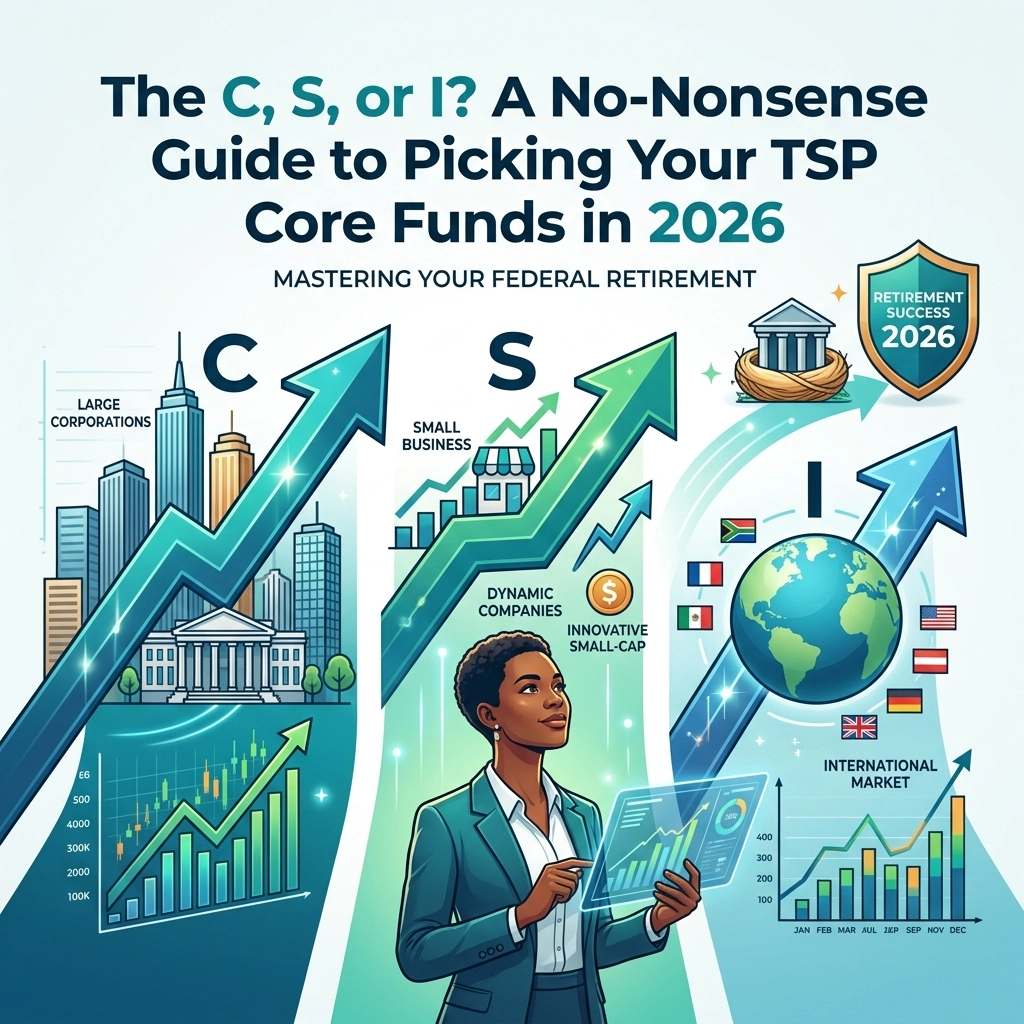
Deciding where to put your money inside the Thrift Savings Plan (TSP) often feels more complicated than it needs to be. For federal employees across the USPS, VA, and DOD, the TSP is the most powerful tool in your retirement arsenal, but many people end up “paralyzed by choice.” They either leave everything in the default Lifecycle (L) funds or, worse, stay in the G Fund for decades, watching inflation erode their purchasing power.
As of May 2026, the market landscape has shifted. We’ve seen incredible runs in international markets and a resurgence in small-cap volatility. If you want to take control of your FERS retirement, you need to understand the “Big Three” core stock funds: The C, the S, and the I.
This guide breaks down exactly what these funds are, how they performed over the last year, and how you should think about mixing them to reach your retirement goals.
1. The Golden Rule: Get Your Match First
Before we talk about which fund is “better,” we have to address the most important rule of federal investing: The 5% Match.
If you are a FERS employee, the government matches your contributions up to 5% of your pay. This is an immediate 100% return on your money. No fund in the TSP: not the C, S, or I: can guaranteed a 100% return in a single day.
- Action Step: Ensure your contribution is at least 5%.
- Why it matters: Leaving this match on the table is like refusing a scheduled pay raise.
2. The C Fund: The Heavyweight Champion
The C Fund (Common Stock Index) is the backbone of most successful federal retirement portfolios. It is designed to track the S&P 500, which represents the 500 largest companies in the United States.
When you buy the C Fund, you are buying a piece of Apple, Microsoft, Amazon, and Berkshire Hathaway.
The Numbers (As of May 2026):
- 1-Year Return: 32.2%
- Year-to-Date (YTD) Return: 8.5%
- Average Annual Return (Since 1987): 10.9%
- Risk Profile: Moderate-to-High. While it is stable compared to smaller stocks, it saw a maximum drawdown of -55.2% during the 2008 financial crisis.
The Verdict: The C Fund is for those who want steady, long-term growth driven by the titans of American industry. It’s generally considered the “safest” of the three stock funds because these companies have massive cash reserves and global reach.

3. The S Fund: The Growth Engine
The S Fund (Small Capitalization Stock Index) tracks the Dow Jones U.S. Completion Total Stock Market Index. In plain English: it tracks almost every U.S. stock that isn’t in the S&P 500. This includes small and mid-sized companies with high growth potential.
The Numbers (As of May 2026):
- 1-Year Return: 31.0%
- Year-to-Date (YTD) Return: 10.2%
- Average Annual Return (Since 1987): 10.1%
- Risk Profile: High. Small companies can grow faster, but they can also fail faster. The S Fund’s maximum drawdown was -57.4%.
The Verdict: The S Fund is the “wild child” of domestic stocks. It has actually outperformed the C Fund so far in 2026. It’s a great addition for younger employees who have 15+ years until retirement and can stomach the roller coaster for the sake of potentially higher rewards.
4. The I Fund: The International Wild Card
The I Fund (International Stock Index) tracks the MSCI EAFE index. This gives you exposure to developed markets outside of the U.S., such as Japan, France, Germany, and the UK. Historically, many federal employees ignored the I Fund because it lagged behind the U.S. markets for a decade.
However, 2026 has told a different story.
The Numbers (As of May 2026):
- 1-Year Return: 37.5%
- Year-to-Date (YTD) Return: 14.2%
- Average Annual Return (Since 1987): 7.0%
- Risk Profile: High. You aren’t just betting on companies; you’re betting on foreign economies and currency exchange rates.
The Verdict: The I Fund is currently the top performer of 2026. While its long-term average (7%) is lower than the C or S funds, it provides essential diversification. When the U.S. dollar is weak or domestic tech stocks stall, the I Fund often picks up the slack. Learn more about your TSP with a complimentary benefits review: Benefits Review Consultation- Federal Benefits Service.

5. How to Mix Your Funds: Three Sample Strategies
Picking just one fund is rarely the best move. Professional allocation usually involves “mixing” these ingredients to match your “stomach” for risk.
The Aggressive Portfolio (15+ Years to Retirement)
If you are early in your career at the VA or DOD, you have time to recover from market dips.
- 50% C Fund (Stability/Large Cap)
- 25% S Fund (Growth/Small Cap)
- 25% I Fund (International Diversification)
- Goal: Maximize growth through broad equity exposure.
The Moderate Portfolio (5-10 Years to Retirement)
As you get closer to the finish line, you want to protect some of your gains.
- 60% C Fund
- 15% S Fund
- 15% I Fund
- 10% G/F Fund (Fixed income for a safety net)
- Goal: Maintain growth while slightly reducing volatility.
The “Set It and Forget It” Approach
If you don’t want to manage this yourself, the L Funds (Lifecycle) automatically shift your money from the C, S, and I into the G and F funds as you get closer to your target retirement date. However, be aware that L Funds can sometimes become too conservative too early, potentially leaving money on the table in your final years of service. Learn more about your Lifecycle funds with a complimentary benefits review: Benefits Review Consultation- Federal Benefits Service.

6. Understanding the Risks: The “Drawdown” Reality
It is very important to do your own analysis and understand that investing in the C, S, or I funds involves the risk of loss. In a “drawdown,” the market value of your account can drop significantly.
Seeing a 50% drop in your statement is terrifying. If that thought makes you want to sell everything, you may need a more conservative allocation. The biggest mistake federal employees make is selling their C, S, and I shares after the market has already dropped, locking in their losses.
7. No Investment Advice: Do Your Own Research
This content is for informational and educational purposes only. Federal Benefits Service does not provide specific investment advice. Every federal employee’s financial situation is unique, and what works for a USPS carrier might not work for a DOD engineer.
Important Notices:
- No Guarantee: Past performance (like the 32% return in the C Fund last year) does not guarantee future results.
- Professional Guidance: It is highly recommended that you consult with a certified financial planner or a benefits specialist before making major changes to your TSP allocation.
- Responsibility: You assume full responsibility for any investment decisions made based on the information in this post.
8. Summary of Action Items
If you’re ready to move beyond the default settings, follow these steps:
- Verify your contribution: Log in to your agency’s payroll system (like LiteBlue for USPS or MyPay for DOD) and ensure you are hitting that 5% match.
- Check your current allocation: Log in to TSP.gov. Are you 100% in the G Fund? If so, inflation might be your biggest enemy.
- Evaluate your timeline: If you have 20 years left, the 2026 volatility is just a blip. If you have 2 years left, it’s time to get serious about capital preservation.
- Set a meeting: If you are unsure about how your TSP fits into your overall FERS pension and Social Security strategy, reach out to us.
Investing doesn’t have to be a headache. By understanding the core strengths of the C, S, and I funds, you can stop guessing and start growing your future.
Contact Federal Benefits Service
For a comprehensive review of your federal benefits and retirement timeline, schedule a consultation with our team. We help FERS employees navigate the complexities of their retirement so they can retire with confidence.