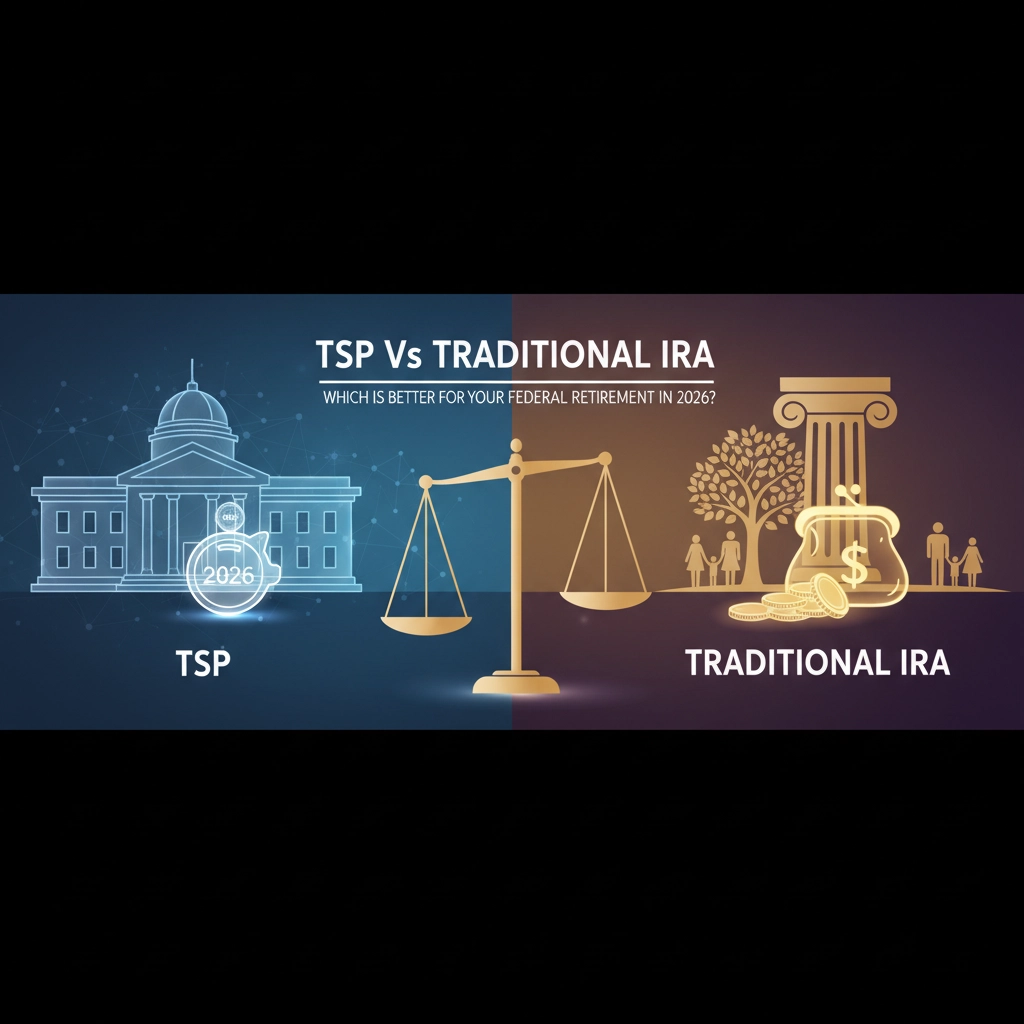
Federal employees face a critical decision when planning for retirement: maximize contributions to the Thrift Savings Plan (TSP) or diversify with a Traditional Individual Retirement Account (IRA). This analysis examines both options based on 2026 contribution limits, fee structures, and investment parameters.
IMPORTANT DISCLAIMER: The information contained in this article is for educational purposes only and does not constitute investment advice. Federal employees must conduct their own research and consult with qualified financial professionals before making retirement planning decisions. Past performance does not guarantee future results.
For personalized retirement planning analysis, schedule a consultation with qualified professionals who understand federal employee benefits.
Understanding the Thrift Savings Plan (TSP) in 2026
The Thrift Savings Plan represents a defined contribution retirement plan exclusively available to federal employees and members of the uniformed services. The TSP operates under specific parameters that distinguish it from other retirement vehicles.
TSP Contribution Limits and Matching Structure
For 2026, the TSP establishes the following contribution parameters:
- Standard Contribution Limit: $24,500 (increase from $23,500 in 2025)
- Catch-Up Contributions (Age 50+): $8,000
- Super Catch-Up Contributions (Ages 60-63): $11,250
Federal agencies provide matching contributions according to a structured formula:
- First 3% of salary: Dollar-for-dollar matching
- Next 2% of salary: 50 cents per dollar matching
- Maximum employer contribution: 5% of annual salary

TSP Investment Options and Fee Structure
The TSP restricts investment selections to five core index funds:
- G Fund: Government Securities Investment Fund
- F Fund: Fixed Income Index Investment Fund
- C Fund: Common Stock Index Investment Fund
- S Fund: Small Capitalization Stock Index Investment Fund
- I Fund: International Stock Index Investment Fund
Additionally, the TSP offers ten Lifecycle Funds (target-date funds) and a Mutual Fund Window with expanded investment options.
Annual Administrative Fees: 0.049% to 0.059% of account balance, representing among the lowest fees in the retirement investment industry.
TSP Limitations and Requirements
Federal employees must acknowledge specific TSP constraints:
- Limited investment diversification compared to self-directed accounts
- Required Minimum Distributions (RMDs) beginning at age 73
- Early withdrawal penalties for distributions before age 59½
- Investment options restricted to TSP-approved funds
NO INVESTMENT ADVICE: This information does not recommend specific TSP fund allocations. Participants must evaluate their risk tolerance and investment objectives independently.
Traditional IRA Analysis for 2026
Traditional Individual Retirement Accounts provide retirement savings opportunities for individuals with earned income, including federal employees seeking additional retirement savings vehicles beyond the TSP.
Traditional IRA Contribution Parameters
For 2026, Traditional IRA contribution limits remain significantly lower than TSP limits:
- Standard Contribution Limit: $7,500
- Catch-Up Contributions (Age 50+): $1,100
- Total Maximum Contribution (Age 50+): $8,600
Traditional IRA Tax Treatment and Deductibility
Traditional IRA contributions may qualify for tax deductions based on:
- Modified Adjusted Gross Income (MAGI) levels
- Filing status (single, married filing jointly, married filing separately)
- Participation in employer-sponsored retirement plans
IMPORTANT: Tax deductibility phases out at specific income thresholds. Federal employees must consult tax professionals to determine their specific deductibility eligibility.

Traditional IRA Investment Flexibility and Costs
Traditional IRAs provide expanded investment options including:
- Individual stocks and bonds
- Mutual funds and exchange-traded funds (ETFs)
- Real estate investment trusts (REITs)
- Certificates of deposit
- Alternative investments (depending on custodian)
Administrative Costs: Traditional IRA fees vary significantly by custodian and may include:
- Annual maintenance fees
- Transaction fees
- Investment expense ratios
- Account closure fees
These costs typically exceed TSP administrative expenses.
Comparative Analysis: TSP vs Traditional IRA
2026 TSP Enhancement: Roth In-Plan Conversions
Beginning in 2026, the TSP will implement Roth In-Plan Conversion capabilities, allowing participants to convert Traditional TSP balances to Roth TSP balances within the same account. This enhancement provides additional tax planning flexibility for federal employees.
CONVERSION CONSIDERATIONS:
- Conversions trigger immediate tax liability on converted amounts
- Converted amounts become subject to Roth distribution rules
- Participants should evaluate current versus future tax rates before converting
DO YOUR OWN RESEARCH: Roth conversion strategies require individual tax analysis. Consult qualified tax professionals before implementing conversion strategies.

Decision Framework for Federal Employees
Scenario 1: Maximize TSP Contributions First
Federal employees should prioritize TSP contributions when:
- Seeking to maximize employer matching benefits
- Requiring low-cost investment options
- Comfortable with limited investment selections
- Focusing on contribution limit maximization
CALCULATION EXAMPLE:
A federal employee earning $80,000 annually receives $4,000 in employer matching (5% maximum). This guaranteed return significantly exceeds most investment alternatives.
Scenario 2: Supplemental Traditional IRA Strategy
Traditional IRA contributions may complement TSP savings when:
- TSP contribution limits are maximized
- Additional tax-deductible contributions are available
- Expanded investment diversification is desired
- Income levels permit full deductibility
Scenario 3: Combined Approach
Federal employees may utilize both TSP and Traditional IRA when:
- Total retirement savings goals exceed TSP contribution limits
- Investment diversification beyond TSP options is required
- Tax planning strategies benefit from multiple account types
RISK ACKNOWLEDGMENT: All investment strategies involve risk of loss. Federal employees must evaluate their individual financial circumstances and risk tolerance before implementing retirement savings strategies.
Implementation Considerations and Warnings
Critical Action Items
Federal employees must:
- Calculate employer matching eligibility to avoid forfeiting free contributions
- Review investment expense ratios across all retirement accounts
- Evaluate tax deductibility limits for Traditional IRA contributions
- Consider future tax rate projections when selecting Traditional vs Roth options
- Plan for Required Minimum Distribution requirements at age 73
Professional Guidance Requirements
SEEK PROFESSIONAL ADVICE: Federal employees should consult with:
- Certified Financial Planners (CFP)
- Enrolled Agents (EA)
- Certified Public Accountants (CPA)
- Fee-only financial advisors
NO GUARANTEES: This analysis does not guarantee investment performance or tax outcomes. Individual results will vary based on market conditions, tax law changes, and personal circumstances.
Conclusion and Next Steps
The TSP generally provides superior value for federal employees through employer matching and low fees, while Traditional IRAs offer investment flexibility at higher costs and lower contribution limits. Most federal employees benefit from maximizing TSP contributions before considering Traditional IRA supplementation.
IMMEDIATE ACTION REQUIRED: Federal employees should review their current contribution rates and ensure maximum employer matching capture.
For personalized retirement planning analysis, schedule a consultation with qualified professionals who understand federal employee benefits.
FINAL DISCLAIMER: This information is current as of December 2025 and subject to change based on legislative actions, regulatory updates, and market conditions. Federal employees must verify current contribution limits and rules before making retirement planning decisions.